


05/01/2020
 Arab Times

Share:

KUWAIT CITY, Jan 4: Kuwait has followed with extreme concern the recent unfortunate events in Iraq and the continued escalation in the region, the dangerous repercussions on security and stability of which it had previously warned of, a Foreign Ministry source said.
In a statement on Friday, the source urged the utmost restraint and understanding in regards to these developments in order to reach a political resolution that avoids further escalation and risks in the region.
The international community was also called on to hastily bear its responsibilities in maintaining the security and stability of this vital region of the world, steering it clear from escalating actions. The State of Kuwait is attentively following up on recent rapid regional developments and their repercussions, said a government official on Friday.
In a press release, head of the Center for Government Communication (CGC) and official Cabinet Spokesman Tareq Al-Mezrem called on all individuals to avoid discourse that might affect national unity and lead to division and trouble. He added that the government had the legal right to pursue those threatening security and stability in the country, especially during the current turbulent situation.
Al-Mezrem affirmed that the Kuwaiti government was keen on bolstering freedom of speech and expression within the mainframe of the Constitution and law.
He called on citizens to promote dialogue in favor of national unity and exercise their rights in a manner that would not defame any sector of society, avoiding all efforts to spread rumors and false information and seek news from official sources. His statement came on the backdrop of the killing of Qassem Soleimani.
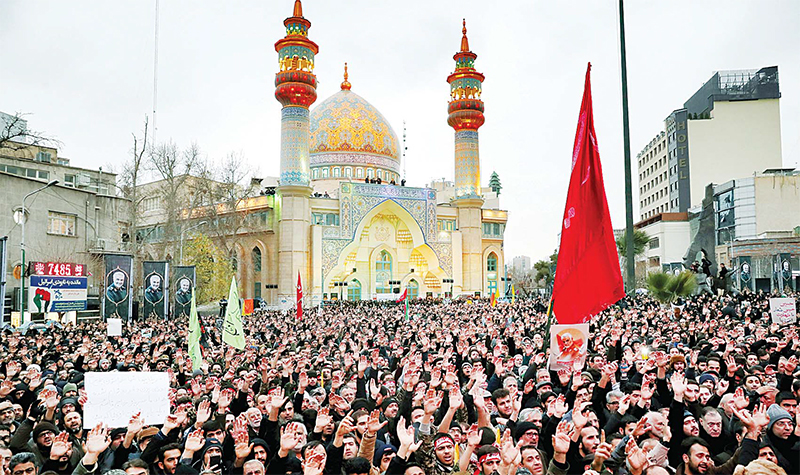
The elimination of Soleimani in a US military strike in Iraq had sparked a series of serious regional and global reactions with most calling on all parties in the region to de-escalate before matters get further complicated. While the main players – the US, Iraq and Iran, are either justifying the operation or expressing utter detest, the world is paying attention and displaying concern to the rapid developments in the region.
Global international player such as Russia said that the US military operation was “reckless” and did not take into account the grave consequences that Soleimani’s killing might bring to the region. The Russian Defense Ministry said Washington’s recent action would surely lead to a complicated political and military situation in the Middle East. The UK, China, and the EU, Turkey as well as Arab nations such as Lebanon and Egypt called for de-escalating tension in the region.
Chinese Foreign Ministry’s spokesman Geng Shuang reflected his country’s concern over the situation. China is against the use of force in carrying out international relations, said the official, calling on all parties involved to abide by the UN charter in this regard.
Shuang also called for respecting Iraq sovereignty and unity to protect peace and stability in the Gulf region and Middle East. In Britain, the UK government has “urged all parties to de-escalate” after the killing of Soleimani in a US air strike in Iraq.
Foreign Secretary Dominic Raab said the UK “recognized the aggressive threat” General Soleimani posed, but “further conflict is in none of our interests”.
The EU called for an end to violence in Iraq, warning of the risk of a flared up situation in the region.
“The cycle of violence, provocations and retaliations which we have witnessed In Iraq over the past few weeks has to stop. Further escalation must be avoided at all cost,” said the President of the European Council, Charles Michel, in a statement. “Iraq remains a very fragile country. Too many weapons and too many militias are slowing the process towards a return to normal daily life for Iraq’s citizens,” he noted. “The risk is a generalized flare up of violence in the whole region and the rise of obscure forces of terrorism that thrive at times of religious and nationalist tensions,” he added.
Turkey also cautioned against turning Iraq and the region into a field to settle score between Washington and Tehran. The Turkish Foreign Ministry called on all involved parties to exercise selfcontrol and avoid further escalation, giving priority to diplomacy to defuse the tension. Arab regional states such as Egypt and Lebanon also released statement in regards to the situation, saying that the killing of Soleimani had increased tension in the region.
Egyptian Foreign Ministry said that Cairo was view the developments with great concern, calling for measures to contain the current problem. Lebanese President Michel Aoun, on his part, also expressed concern over the situation during a phone call with Iranian counterpart Hassan Rouhani. Aoun said that the elimination of Soleimani came at a critical period in the region, which increases the tension experienced by all countries in the region.
Earlier, the Pentagon said, the military operation was a decisive defensive action to protect American personnel abroad, adding that it aimed at deterring future Iranian attack plans. The Pentagon indicated that all necessary action would be undertaken to protect the American people and interests around the world. The military strike came after an attempt to breach the US embassy in Baghdad in the previous days. The US military strike had some strong reactions from Tehran and Baghdad with both condemning the action occurring on Iraqi soil.
Iran’s Foreign Ministry today summoned the Swiss charge d’affairs, tasked with looking after American interests in the nation, to expressed utter condemnation to the killing of Soleimani. Iranian Foreign Minister Mohammad Javad Zarif said that Tehran would mobilize all its “political and legal potentials to bring the American administration to account.” The operation also garnered negative reactions from officials in Baghdad with Prime Minister Adel Abdul- Mahdi condemning the action, while President Barham Saleh called the incident an act of “aggression”. Security was beefed up in Baghdad following the killing of Soleimani.
Saudi Arabia on Friday stressed the importance of self-restraint to ward off what may lead to exacerbating the situation, in light of threats posed to the region’s stability and security. With knowledge of the terrorist militias’ threats to the region’s security that should be halted, Saudi Arabia, in light of the rapid developments, calls for self-restraint to refrain from all acts that may lead to worsening the situation with unbearable consequences, an official source was quoted by Saudi Press Agency (SPA) as saying.
Saudi Arabia has followed the events in Iraq that came as a result of the escalation of tensions and terrorist acts that the Kingdom has previously denounced and warned against their repercussions, the source, who spoke on condition of anonymity, said. Saudi Arabia reiterated that the international community must assume its responsibilities to take the necessary measures so as to ensure the security and stability of this vital region to the world, the source noted.
By Ahmed Al-Naqeeb and Saeed Mahmoud Saleh Arab Times Staff and Agencies